What Is Flame Retardant Polyester and How Does It Work?
Flame Retardant Polyester is becoming an important material for safer interiors, transport fabrics, protective clothing, and technical textiles. Grand View Research valued the global flame retardant chemicals market at approximately USD 7.1 billion in 2023. It also forecasts continued growth through 2030. These figures indicate strong industrial demand, but they do not prove that every flame-retardant fabric performs equally.
Flame Retardant Polyester works through chemistry and fabric structure. Some grades contain phosphorus-based comonomers within the polymer chain. Others use carefully selected additives during production. When exposed to heat, the material can form a protective char layer, reduce combustible gases, and limit flame spread. Certain polyester fabrics may also melt and drip away from the ignition zone. That behavior can reduce burning in some applications. It can also create hazards if droplets ignite nearby materials.
Textile-fire researcher Richard Horrocks is often associated with this practical warning: “There is no such thing as a flameproof textile; only flame-retardant textiles.” The distinction matters. Flame resistance is not permanent protection. Washing, abrasion, finishing chemicals, fabric weight, and construction can change performance. Reports from MarketsandMarkets and Allied Market Research show rising demand for flame-retardant materials, yet market forecasts remain estimates, not guarantees.
Real performance requires testing. EN ISO flame-spread tests, ASTM methods, and application-specific standards should guide product selection. A laboratory result is only one piece of evidence. A curtain, aircraft seat, and workwear fabric face different heat sources and failure risks. This topic deserves careful scrutiny, because “self-extinguishing” can sound safer than it really is.
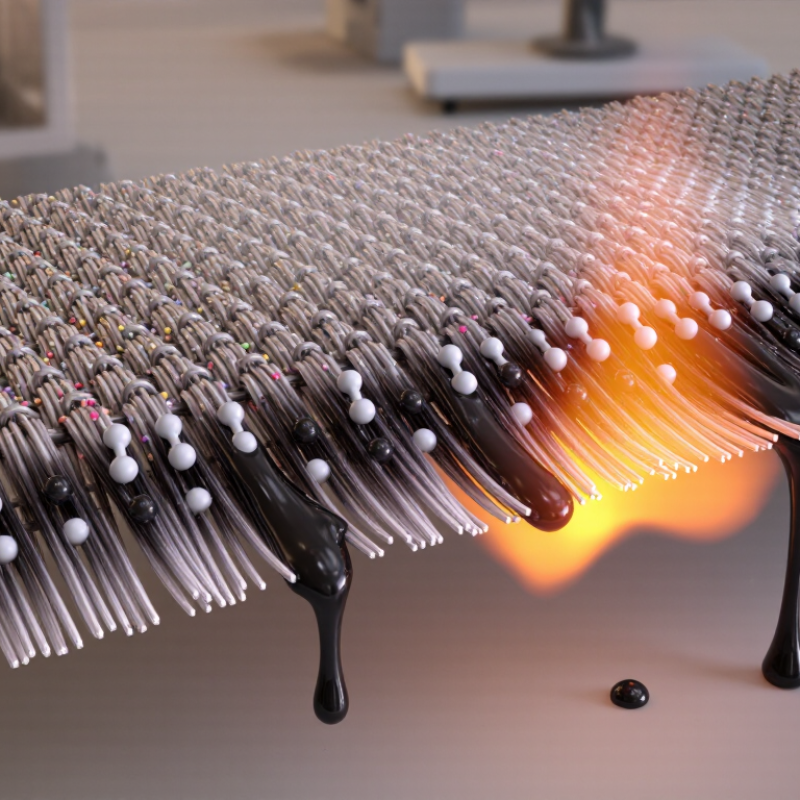
Definition and Core Properties of Flame Retardant Polyester
Flame retardant polyester is a polyester fiber or fabric designed to resist ignition and slow flame spread. Manufacturers usually modify the polymer with reactive phosphorus compounds or add flame-retardant agents during spinning. Some treatments are applied after weaving. The method changes durability. Reactive chemistry is generally more permanent, while surface finishes may weaken after repeated washing. Polyester still melts under intense heat. It is not fireproof.
Its core properties include delayed ignition, reduced flame propagation, and limited afterflame time. Testing often follows ASTM D6413 or ISO 15025 procedures. These tests measure burning behavior under controlled conditions, not every real-world fire. The limiting oxygen index can also indicate flammability. A higher value usually means the material needs more oxygen to sustain burning. However, test results can change with fabric weight, construction, moisture, and laundering. That detail is easy to overlook.
Tips: Check the test method, fabric weight, and wash-cycle results before selecting a specification. The U.S. Fire Administration reported 1.39 million fires in the United States during 2023, showing why controlled flame behavior matters across furnishing and protective-textile applications. Still, flame retardancy is only one safety layer. Seams, coatings, heat exposure, and garment fit also influence performance. In practice, a fabric may pass a laboratory test yet behave differently near a strong heat source. That uncomfortable gap deserves attention.
What Is Flame Retardant Polyester and How Does It Work? - Definition and Core Properties of Flame Retardant Polyester
| Data Dimension | Typical Information | Why It Matters |
|---|---|---|
| Definition | Polyester engineered to resist ignition, reduce flame spread, and limit heat release compared with standard polyester. | Provides additional time for fire detection, evacuation, and suppression. |
| Polymer Basis | Usually polyethylene terephthalate (PET), a thermoplastic polyester widely used in fibers, fabrics, films, and molded products. | The PET structure provides strength, dimensional stability, and compatibility with established textile-processing methods. |
| Flame-Retardant Design | May use phosphorus-containing comonomers, reactive additives, or carefully selected finishes. Inherently modified grades incorporate the flame-retardant component into the polymer during manufacture. | The design determines durability, processing behavior, smoke generation, and resistance to laundering or cleaning. |
| Primary Flame Mechanism | During heating, some phosphorus-based systems promote char formation and create a protective condensed-phase barrier. Other systems can interfere with flame chemistry in the gas phase. | The barrier reduces heat and mass transfer between the polymer and the flame. |
| Ignition Behavior | Flame-retardant polyester is designed to make ignition more difficult or to delay sustained burning; performance varies with fabric construction, mass, airflow, and test method. | A material that delays ignition can reduce the likelihood of rapid fire development. |
| Limiting Oxygen Index | Standard PET commonly has a limiting oxygen index of approximately 20–22%; modified flame-retardant polyester can reach higher values, often around 26% or above, depending on formulation. | A higher value indicates that a higher oxygen concentration is required to sustain combustion under the test conditions. |
| Melt Behavior | Polyester is thermoplastic and can melt, shrink, or form molten material when exposed to sufficient heat. Flame retardancy does not eliminate thermal degradation or melt-related hazards. | Product design must address heat exposure, molten polymer, and potential shrinkage in addition to flame spread. |
| Thermal Decomposition | PET generally begins significant thermal decomposition at several hundred degrees Celsius, with the exact onset depending on heating rate, atmosphere, additives, and sample history. | Thermal stability affects processing windows, service temperature, and fire-test results. |
| Smoke and Toxicity | Smoke and combustion products depend on oxygen availability, temperature, ventilation, polymer formulation, dyes, finishes, and the surrounding materials. | Flame resistance should never be treated as proof of low smoke or low toxicity; these properties require separate testing. |
| Tensile Strength | Typical polyester textile fibers have tenacities of approximately 3–8 cN/dtex, depending on fiber type and processing. Flame-retardant modification may change the value. | Strength determines suitability for upholstery, workwear, transportation textiles, and technical fabrics. |
| Moisture Regain | Polyester has low moisture regain, commonly around 0.4% under standard textile-conditioning conditions. | Low moisture absorption supports quick drying and helps maintain dimensional stability. |
| Dimensional Stability | Generally good because polyester absorbs little moisture and can be heat-set; excessive heat can still cause shrinkage or deformation. | Stable dimensions improve fit, appearance, and performance in repeated-use products. |
| Chemical Resistance | Generally resistant to many dilute acids and common solvents, but vulnerable to strong alkalis, high-temperature hydrolysis, and selected chemicals. | Chemical exposure can affect strength, color, surface finish, and flame-retardant performance. |
| Durability of Flame Retardancy | Inherently modified polyester generally retains flame-retardant functionality better than a surface-only finish, although wear, hydrolysis, processing, and contamination can still affect performance. | Durability is essential for products exposed to washing, abrasion, weathering, or prolonged service. |
| Common Product Forms | Staple fiber, filament yarn, woven fabric, knitted fabric, nonwoven material, film, resin, and molded components. | The form influences surface area, heat transfer, fabric density, and the final fire-test result. |
| Typical Applications | Curtains, upholstery, mattresses, protective clothing, transportation interiors, electrical insulation, industrial textiles, and building-related fabrics. | Applications are selected according to the required fire, mechanical, comfort, durability, and regulatory performance. |
| Performance Verification | Relevant evaluations may include vertical or horizontal flame tests, limiting oxygen index, cone calorimetry, smoke testing, laundering durability, abrasion resistance, and tensile testing. | No single test describes every fire hazard; the correct standard depends on the intended product and jurisdiction. |
Note: Values are representative ranges for general comparison. Actual performance depends on polymer chemistry, additive level, fiber or fabric construction, processing conditions, specimen preparation, and the applicable test standard.