China Top 10 Vegan Gelatine Powder Suppliers
Choosing among China’s Vegan Gelatine Powder suppliers takes more than comparing prices. The name can be confusing: these products do not contain animal gelatin. They typically use plant-based or microbial ingredients, such as agar, carrageenan, pectin, or starch blends. Formulas behave differently. A powder that sets a fruit dessert well may not give a smooth texture in a gummy or dairy-free alternative.
This guide to China’s top 10 suppliers offers a starting point for buyers, not a substitute for testing. Compare ingredient declarations, technical data sheets, batch consistency, and available quality documents. Ask for a recent sample and test it in your own recipe. Check how it disperses in warm water, whether it forms lumps, and how the finished product holds after cooling. Small details matter.
Look for clear answers about sourcing, production controls, packaging, and export experience. Request the recommended dosage and setting conditions for your application. A supplier’s response can reveal as much as its brochure. No shortlist is perfect. Rankings may change as products, service, and documentation change, so verify claims directly before placing an order. This article highlights practical questions to help you assess suppliers with care. It also leaves room for a useful doubt: “vegan” alone does not guarantee the texture, stability, or performance your product needs.
Plant-Based Gelatin Explained: Agar, Pectin, Carrageenan, and Gellan Gum
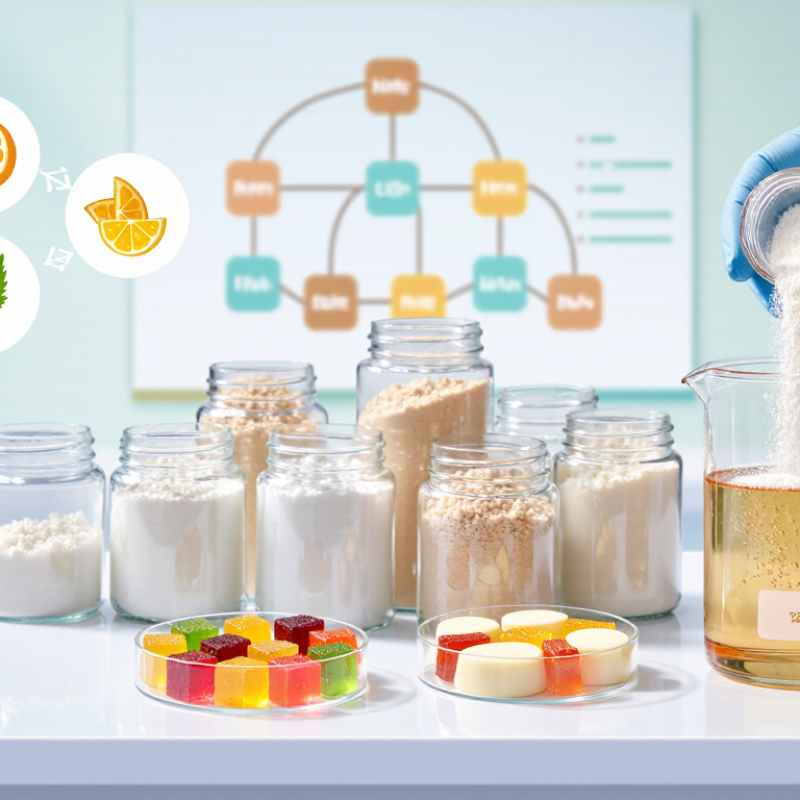
“Vegan gelatine” usually means a plant-based gelling agent, not gelatin made from plants. Agar, pectin, carrageenan, and gellan gum behave differently in a recipe. Choosing one by name alone can lead to a firm dessert—or a disappointing one.
Agar, extracted from seaweed, sets firmly as it cools and generally needs heating to dissolve. It works well in cubes and molded sweets, but can feel brittle if used too heavily. Pectin comes from fruit and is common in jams. Its setting depends on the type, acidity, and sugar level, so a supplier’s technical sheet matters. Small recipe changes can alter the result.
Carrageenan, also seaweed-derived, is used in dairy-style drinks and soft desserts; its performance depends on the grade and other ingredients. Gellan gum can create clear, precise gels at low use levels, though it may need careful mixing and temperature control. Check specifications, batch consistency, and sample performance before placing a large order with a Chinese supplier. Ask for food-grade documentation and test the powder in your own formula. I would not assume one sample tells the whole story. Retesting is worthwhile.
How China’s Top 10 Suppliers Compare by Capacity, Exports, and MOQ
China’s top ten vegan gelatine powder suppliers are best compared through verified capacity, export evidence, and minimum order quantity (MOQ). Capacity figures should specify product grade and monthly output, not total factory production. Export records reveal shipping experience, but they do not prove consistent quality. MOQ matters too: a low threshold can help buyers test a 25-kilogram sample lot before ordering pallets. The comparison is imperfect. Public disclosures vary widely.
The FAO’s The State of World Fisheries and Aquaculture 2024 reports 37.8 million tonnes of aquatic plants produced globally in 2022. This indicates a substantial seaweed feedstock base, not China’s refined agar or carrageenan capacity. UN Comtrade export data can help check trade flows, but customs categories may not isolate vegan gelatine powders. Buyers should request product-specific capacity, recent shipment documents, and batch test reports. Those details make supplier comparisons more reliable than headline claims.
Tips: Ask for MOQ by grade and packaging size. Confirm lead time, sample cost, and export destination. Small trial orders are useful, but may not reflect full-scale consistency.
Compare Technical Data: Gel Strength (g/cm²), Viscosity (mPa·s), and Dosage
For a China-focused top-ten supplier comparison, list gel strength, viscosity, and dosage only beside their test conditions. Gel strength reported in g/cm² is useful only when concentration, setting time, and temperature match. The Gelatine Manufacturers of Europe Gelatine Handbook uses a 6.67% gel and a 10°C test for Bloom strength. That is a reference point, not a direct conversion for plant-based powders. Small differences matter.
Viscosity in mPa·s also needs context: temperature, solution concentration, spindle, and rotation speed can change the result. The FAO/WHO JECFA Compendium of Food Additive Specifications treats agar, carrageenan, and pectin as distinct additives, so one viscosity figure cannot rank every vegan gel. Ask suppliers for the test method and a batch-specific certificate. A number without conditions is weak evidence.
Dosage should be shown as a working range, not a universal promise. Request the percentage used in a real formulation, plus pH, sugar level, heating method, and target texture. Then test a small batch: a spoonful that sets cleanly in a cool room may soften in a warm filling. I would be cautious of tidy rankings; supplier data often use different methods, and that makes direct comparison imperfect.
Verify Food-Grade Compliance Against GB 2760 and ISO 22000 Records
When comparing China’s top ten vegan gelatine powder suppliers, treat “vegan gelatine” as a functional description, not a regulatory category. Request the complete formulation, including carriers, colours, acidity regulators, and processing aids. Check each additive against the current GB 2760 entry for its food category, permitted function, and use level. A “food-grade” declaration is not enough. Ask for batch-linked specifications, certificates of analysis, and traceable raw-material records. Check identity, moisture, microbiological limits, heavy metals, lot number, and test date. Small details matter.
ISO 22000 records help assess food-safety management, but certification alone does not prove that a powder complies with GB 2760. Verify the certificate’s legal entity, production-site address, ingredient-related scope, validity, and latest surveillance status. Match the batch’s certificate of analysis to the same site and formulation. The WHO’s 2015 Estimates of the Global Burden of Foodborne Diseases estimated 600 million illnesses and 420,000 deaths worldwide each year. Those figures make documented controls worth a careful review. Paperwork can still mislead. Ask how specification changes are managed and whether retained samples are available; these checks are practical, though not perfect.
China Vegan Gelatine Powder Supplier Checks: Food-Safety Standard Timeline
Key publication and implementation years for standards relevant to food-additive and food-safety-system verification.
GB 2760-2024 was published in 2024 and took effect on February 8, 2025. ISO 22000:2018 was published in 2018. These milestones provide verification context; they do not indicate or certify any individual supplier’s compliance. Confirm applicable ingredient permissions and conditions under GB 2760, and verify current food-safety certificates directly with the issuing body.
Assess Quality and Cost by Purity (%), Particle Size (μm), and Price per kg
When comparing China’s top 10 vegan gelatine powder suppliers, start with the specification sheet, not the headline price. Plant-based gelling powders may use different ingredients, so a “purity” figure is meaningful only when the supplier explains what it measures. Ask for a recent batch certificate and confirm the test method. Small differences can matter. A powder listed at 98% purity may not perform like another product with the same figure if moisture or blending differs.
Particle size affects handling and dispersion. Finer powder may hydrate faster, while coarser particles can be easier to measure but may form lumps in a cool liquid. Check the stated size in micrometers (μm), and test a sample in your actual recipe. A simple kitchen-style check is useful, but it does not replace controlled testing. I’ve seen comparisons focus too heavily on the number; that can be misleading.
Tips: Compare price per kg only after checking purity, particle size, minimum order, and shipping costs. Request samples from shortlisted suppliers, then record dissolution time, texture, and gel strength under the same conditions. Keep notes. The first trial may be inconsistent, especially when mixing temperature or stirring speed changes. Ask suppliers how often specifications are verified, and treat unusually low quotes as a reason to ask more questions—not as proof of poor quality.