How to Buy Hot Rolled Steel Bar in 2026?
Buying hot rolled steel bar in 2026 requires more than comparing one supplier’s price. Buyers must examine grade, diameter, tolerance, surface condition, certification, and delivery risk. A bar may look sound under warehouse lighting, yet contain scale, bends, or inconsistent dimensions. Small differences can create machining delays and unexpected scrap.
The World Steel Association reported approximately 1,884.6 million tonnes of crude steel production worldwide in 2024. Its World Steel in Figures 2025 also shows a highly concentrated production market, with China remaining the largest producer. Meanwhile, the OECD Steel Outlook 2025 warns about persistent global overcapacity and uneven steel demand. These conditions may increase competition among mills, but they do not guarantee lower prices. Freight, energy costs, currency movements, and regional trade measures still influence the final quotation.
“Steel is the backbone of the world economy,” said Lakshmi Mittal, Executive Chairman of ArcelorMittal. That observation remains relevant when evaluating hot rolled steel bar for construction, machinery, frames, and general fabrication. Buyers should request mill test certificates, heat numbers, chemical analysis, tensile results, and dimensional records. Confirm whether ASTM, EN, JIS, or another standard applies. Also clarify whether the quoted length is fixed or random.
The cheapest offer may not be the lowest total cost. It is an imperfect assumption, but a useful warning. A reliable purchase decision connects technical requirements with verified supplier performance, realistic lead times, and documented inspection procedures.
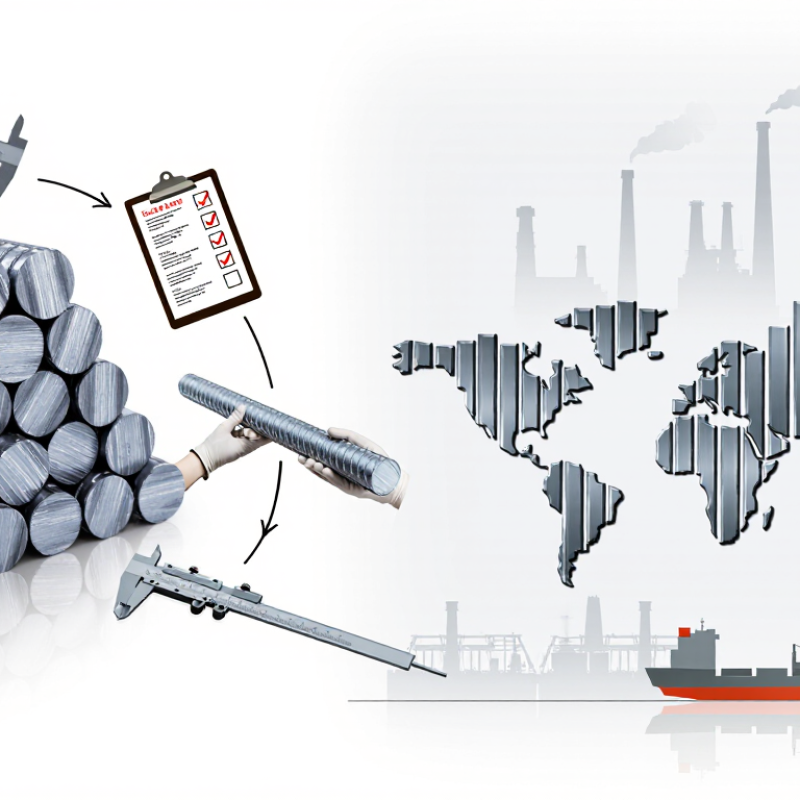
What Hot Rolled Steel Bar Is and Where It Is Used
Hot rolled steel bar is formed while steel is above its recrystallization temperature. The process passes heated billets through rolling stands until they reach a round, square, or flat profile. Cooling happens in open air. This creates a dark mill scale and wider dimensional tolerances than cold-finished bar. The surface may look rough. That is normal.
The material is used where strength, weldability, and practical cost matter more than a polished finish. Round bars become shafts, pins, axles, and machine supports. Flat and square bars serve in frames, brackets, gates, and agricultural equipment. Reinforcing bars strengthen concrete structures, while heavier sections support bridges, warehouses, and industrial platforms. Construction remains the largest steel-consuming sector, at roughly half of global demand, according to the World Steel Association. Its World Steel in Figures 2024 report recorded about 1.89 billion tonnes of crude steel production in 2023. The scale is enormous, but quality still depends on the individual batch.
When buying in 2026, check the grade, diameter, length, surface condition, and applicable standard. Request a mill test certificate with chemical composition, yield strength, tensile strength, and elongation. ASTM, EN, and national standards can use different designations. Do not compare names alone. Verify actual chemistry and test values. USGS Mineral Commodity Summaries 2025 also shows the steel supply chain remains tied to massive global iron ore output, so transport and raw-material changes can affect pricing. A common mistake is choosing the lowest quote before checking tolerances. Cheap bar can become expensive during cutting, welding, or machining. Some assumptions need testing.
| Data Dimension | Specification or Grade | Typical Data | Common Applications | Buying Considerations |
|---|---|---|---|---|
| Material Overview | ||||
| Manufacturing process | Hot rolling | Steel is rolled above its recrystallization temperature, commonly producing a scaled surface and wider dimensional tolerances than cold-finished bar. | Structural members, fabricated frames, machinery parts, shafts, supports and general metalwork. | Specify whether the surface scale is acceptable or whether descaling, machining or shot blasting is required. |
| Typical product shapes | Round, square, flat, hexagonal and rectangular bar | Available dimensions depend on the applicable standard, production capability and supply market. | Round bar for shafts; flat bar for brackets; square bar for frames; hexagonal bar for machined components. | State the exact shape, nominal dimensions, length, dimensional tolerance and straightness requirement. |
| Nominal density | Carbon and low-alloy steel | Approximately 7.85 g/cm³, or 7,850 kg/m³. | Used for estimating shipment weight and material requirements. | Actual invoiced weight may be based on theoretical weight, actual scale weight or the contract terms. |
| Surface condition | As-rolled | Normally includes mill scale and may show minor surface imperfections permitted by the relevant standard. | Welded structures, fabricated parts and applications where a bright surface is not essential. | For painting, coating or precision machining, include surface preparation and defect-removal requirements in the order. |
| Representative Grades and Mechanical Properties | ||||
| Structural carbon steel | ASTM A36 | Minimum yield strength: 36 ksi / 250 MPa. Tensile strength: 58–80 ksi / 400–550 MPa. | General structural frames, base plates, brackets, supports and welded fabrications. | Confirm the product form and thickness because mechanical requirements can vary by product specification. |
| High-strength structural steel | ASTM A572 Grade 50 | Minimum yield strength: 50 ksi / 345 MPa. Minimum tensile strength: 65 ksi / 450 MPa. | Bridges, buildings, heavy frames, transportation structures and load-bearing fabrications. | Use when higher strength may reduce section weight; verify weldability, thickness limits and impact requirements. |
| Structural steel | EN 10025-2 S275JR | Minimum yield strength: 275 MPa for nominal thickness up to 16 mm. Tensile strength: typically 410–560 MPa. | General construction, platforms, frames, stairs and welded steelwork. | Check the required delivery condition, thickness category, impact designation and inspection documents. |
| Medium-carbon steel | AISI 1045 / C45-type material | Nominal carbon content is approximately 0.45%; strength and hardness depend strongly on size, rolling condition and heat treatment. | Shafts, pins, axles, studs, gears and other parts requiring greater strength than low-carbon steel. | Request the applicable chemical and mechanical specification rather than relying only on the commercial grade name. |
| Reinforcing steel bar | ASTM A615 Grade 60 | Minimum yield strength: 60 ksi / 420 MPa. Minimum tensile strength: 80 ksi / 550 MPa. | Reinforced concrete slabs, beams, columns, foundations and retaining structures. | Confirm bar number, nominal diameter, deformation pattern, bend requirements, splice design and certification. |
| Dimensions, Weight and Ordering Data | ||||
| Round-bar theoretical weight | Metric calculation | Weight per metre ≈ d² × 0.006165 kg/m, where d is the diameter in millimetres. | Budgeting, truck-load planning, cutting lists and material take-offs. | Example: a 20 mm round bar weighs approximately 2.47 kg/m before allowance for tolerance and scale. |
| Flat-bar theoretical weight | Metric calculation | Weight per metre ≈ width × thickness × 0.00785 kg/m, with width and thickness in millimetres. | Plates, brackets, cleats, frames and fabricated supports. | Example: a 50 × 10 mm flat bar weighs approximately 3.93 kg/m. |
| Common stock lengths | Commercial supply lengths | Short lengths and standard mill lengths are commonly offered; exact availability varies by section, grade and market. | Fabrication shops, construction projects and cut-to-length orders. | Specify fixed length, random length, permitted length tolerance, bundle quantity and cutting allowance. |
| Dimensional tolerance | Applicable product standard | Hot-rolled dimensional tolerances are generally wider than those of cold-drawn or precision-ground bar. | Suitable for welding, fabrication and machining operations with adequate allowance. | Quote the governing standard, nominal size, tolerance class, straightness and out-of-roundness requirements. |
| Application and Purchase Checklist | ||||
| Structural fabrication | Low-carbon or structural grades | Prioritize yield strength, tensile strength, weldability, thickness and impact requirements. | Columns, beams, platforms, frames, supports and steel structures. | Request a material test certificate and verify compliance with the project design code. |
| Machined components | Medium-carbon or alloy grades | Prioritize chemistry, machinability, hardness, straightness, machining allowance and heat-treatment condition. | Shafts, pins, axles, couplings, gears and industrial components. | Define the final machined dimensions and allow sufficient stock for scale removal and machining. |
| Reinforced concrete | Deformed reinforcing bar | Prioritize bar diameter, grade, rib geometry, bend performance, ductility and applicable building standard. | Concrete beams, slabs, columns, foundations and walls. | Do not substitute general smooth round bar for reinforcement unless the structural design specifically permits it. |
| Quality documentation | Inspection and traceability | Typical documents may include a material test certificate, heat number, chemical analysis, mechanical results and dimensional inspection. | Safety-critical, regulated, export and engineered construction projects. | Match the heat number and inspection records with the delivered bundles or tags. |
| Quotation details | Purchase specification | Include grade, standard, shape, dimensions, length, quantity, tolerance, surface condition, delivery condition and documentation. | All hot rolled steel bar purchases. | Clear specifications reduce substitutions, rework, cutting waste and disputes over weight or compliance. |
| Note: Mechanical properties and chemical limits are representative minimums or typical ranges from commonly used standards. Always purchase against the current edition of the applicable standard and verify the exact product form, thickness, delivery condition and certified test results. | ||||
Related Posts
-
Why Choose Hot Rolled Bars for Construction?
-
2026 Best Hot Rolled Steel Bar Types for Global Buyers
-
What Is Hot Rolled Steel Bar A Buyers Guide?
-
Top 10 Benefits of Using Hot Rolled Bars in Construction and Manufacturing
-
Top 10 Hot Rolled Steel Grades You Need to Know?
-

Need Steel Tips for Global Buyers to Source Efficiently?